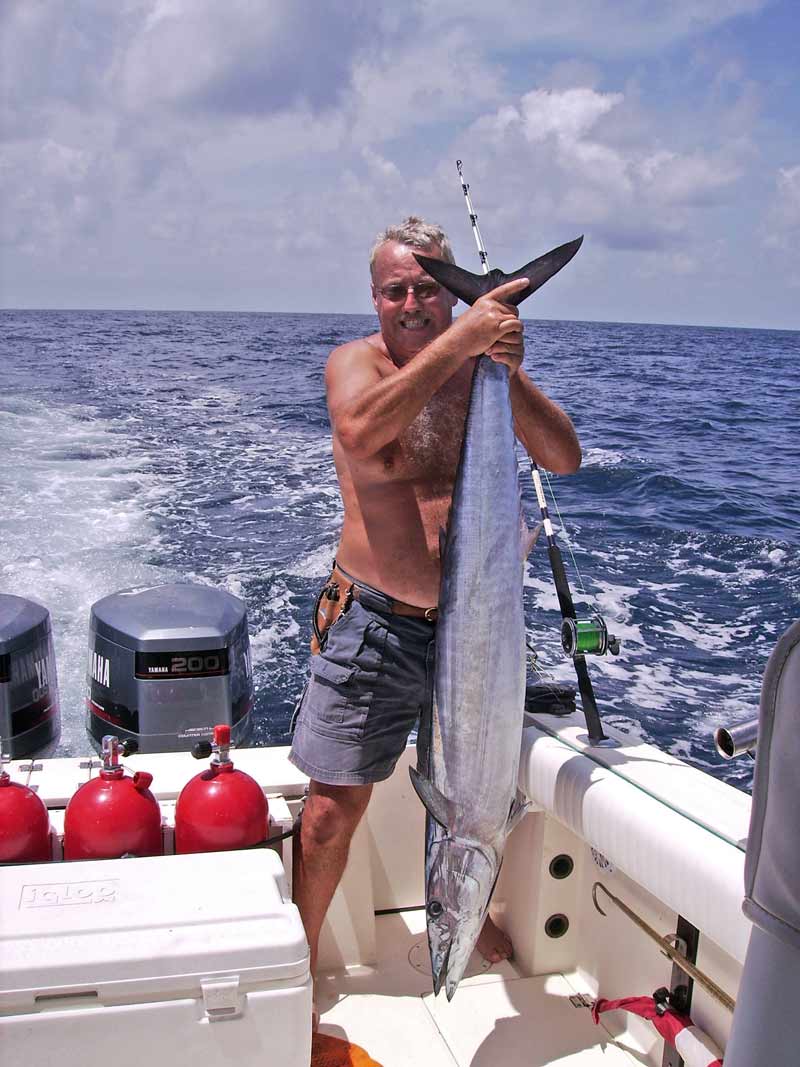
Floriday Keys Wahoo

January 30, 2009 by  
Filed under Photo Contest

Gordon Forget and his Floriday Keys Wahoo

Gordon Forget and his Floriday Keys Wahoo

Gordon Forget of Islamorada, Florida in the Florida keys sent us this picture of a magnificent Wahoo. He caught this fish while trolling for Dolphin (Mahi) along the weed lines near the Islamorad hump.

VN:F [1.9.22_1171]
Rating: 6.3/10 (15 votes cast)
VN:F [1.9.22_1171]
Rating: +2 (from 2 votes)

Everglades Black Bear

January 30, 2009 by  
Filed under Photo Contest

This photo was sent to us from Glades_walker  of South Florida.

Everglades (Big Cypress) Black Bear

Everglades (Big Cypress) Black Bear

This bear photo was taken on an inexpensive deer cam that I purchased at bass pro shops. I hike frequently in the Big Cypress area of the Florida Everglades and came across some bear tracks. I placed the camera at the cross section of a game trail and buried my last doghnut a few feet in front. This picture of a black bear taken in February of 2006 was the result. Its amazing how much fun you can have with even the least expensive trail cameras!

VN:F [1.9.22_1171]
Rating: 8.9/10 (31 votes cast)
VN:F [1.9.22_1171]
Rating: +3 (from 3 votes)

Go Climb a Tree Stand!

January 30, 2009 by  
Filed under Hunting

This year I had the great opportunity to try my hand at deer hunting from a tree stand. Being new to the sport of bow hunting, I had spent the previous summer visiting friends in the area I was likely to hunt, where they were kind enough to enlighten in to the incredible adventure to come that fall. My coach for a large part of this ‘training’ was Dave Sumner, the inventor of the “Turkey Dave Footrest” and “FlirtyGirty” panfish jigs.  Dave is an accomplished hunter and would not let me place any tree stands until I had a better than average grasp of bow hunting. Dave and I walked the game trails each and every time I would visit Wisconsin from my home in Miami, Florida. He gave me excellent instruction on not only how to find well used deer trails but how to walk them without telegraphing to the deer that I had  been there.  My friend would give me what we called “Ishi” points for each task I performed correctly in my quest to become a bow hunter. Ishi was the name of the last Yana Indian, who was a legendary woodsman and hunter, he died in 1916. These tasks included, not only finding the deer sign and trails, but understanding why deer would be in this area and which way they may be coming from. I was also taught to understand the prevailing wind patterns for the seasons in determining where a tree stand should be placed.  In all honesty,  this education had been going on for nearly two years and I had promised not to draw my bow on an animal until I had accumulated a sufficient number of “Ishi” points to satisfy both Dave Sumner and another friend Dave Roll (the cameraman for Northland Adventures w/Dave Carlson). These guys are true woodsman and would actually ban me from hunting their land if I had ever attempted to use anything in addition to knowledge to harvest a deer.


After, what I considered a very lengthy education, I was taken into the woods on late summer day and was asked to point out any places I would consider placing a tree stand. If I found such as spot, I would then have to give a minimum of 6 reasons that I would consider placing a stand at that spot.  These reasons may have included, nearby food sources, scrapes, wind direction, water sources among many others. We then placed several stands that could be used depending on the direction of the wind.


That fall, I found myself preparing to sit in my tree and give my first crack at taking a deer with a bow, actually I had never taken a deer before so this was my initiation! After several unsuccessful journeys into the woods, I found myself sitting in my tree stand one late afternoon, trying to remember all the words to Jimmy Buffett’s “Cheese burger in paradise, when I heard the leaves crunching to my right.  A doe had come up the trail and was moving into range.  Being a left handed shooter this was a very good side for me but I had limited shooting alleys.  The deer mad a sharp left and I knew I would have one chance to stand and draw under cover of a large Oak tree. With my heart pounding, I stood and pulled back my bow, as the doe emerged from behind the tree I let my arrow fly. At first I wasn’t sure I had hit her as the doe took off like a bat out of hell and I saw my arrow stuck in the ground. The lack of foliage this time of year made it easy to watch the animal run about 75 yards turn around, wobble and lay down.


I wouldn’t say I panicked at that point as much as I was giddy with excitement, and this being my first deer I was a bit perplexed at what to do next. I remember my friends telling me not to chase the animal for about 30 minutes or more after the shot, ‘BUT THIS WAS MY FIRST DEER!!!!’ So I did what any city boy would do in this situation, I called Dave Roll and exclaimed, “I got one” and “I’m freaking out!” My buddy who has been in this situation very calmly said “ what stand are you in, I’ll be there in 30 minutes, stay in the stand till I get there”.  It didn’t matter that I could see the animal lying on the ground, I stayed in my stand.  Of course I called just about everyone I know from that stand, which led to my friends ridiculing me for taking my cell phone into the woods and calling without there being an emergency. The bottom line, I took a very nice doe at 34 yards, and have been hooked on bow hunting ever since, and boy do they taste great when you harvest venison yourself!

VN:F [1.9.22_1171]
Rating: 6.0/10 (1 vote cast)
VN:F [1.9.22_1171]
Rating: 0 (from 0 votes)

Ice Fishing For WhiteFish

January 26, 2009 by  
Filed under Fishing

Ice fishing for Whitefish


For those of you who live in areas more prone to hurricane damage than frostbitten fingers, you may not have ever heard of the whitefish. It’s a cold water species closely related to the chub and found in deep water lakes and river systems of the north. Whitefish can easily grow to 2 feet in length, but a typical catch is in the upper teens to low twenties of inches. The old size limit for commercial fishers on Lake Michigan was set at 17 inches. Whitefish fillets are a very delicate flavor that accepts a variety of seasonings extremely well. It’s commonly used in the classic fish boils that take place on the Door County peninsula area near Green Bay, WI. 
 
Whitefish numbers seem to be on the rise in Lake Michigan and state game biologists say that they’re now equal to the yellow perch as a wintertime target species. They can be fished anywhere from 5 to 50 feet deep. Their original forage was a small organism that closely resembles a scud, but that food source has all but disappeared because of the incursion of the exotic zebra mussel – brought to the Great Lakes years ago by ocean going vessels emptying their bilges that were infected with the zebra’s juvenile stage. With the native food source depleted, whitefish populations decreased dramatically, but there’s good evidence that they’re making a comeback by converting over to another species – ironically, another non-native exotic: the European Goby. These small minnow-like fish are increasingly being found in the stomach contents of caught whitefish. Because of this, fishing for whitefish with small jigging spoons in gold or silver finish that mimic the Goby or minnow-tipped lead jigs works well. Whitefish tend to feed very near the bottom so drop the lure all the way down into the sand or mud every now and then. In fact, stirring up the sediment may serve to attract the curious fish, as was shown with underwater cameras on a recent trip to Sturgeon Bay, WI. 
 

Whitefish now rival yellow perch for interest amongst Great Lakes ice fisherman. 

VN:F [1.9.22_1171]
Rating: 7.8/10 (6 votes cast)
VN:F [1.9.22_1171]
Rating: 0 (from 0 votes)

Islamorada Hump Wahoo

January 22, 2009 by  
Filed under Fishing

It was a beautiful Florida Keys dawn as we headed out from Tavernier Creek Marina with high hopes of trolling up some tasty table fare for the friends that were coming to visit us later on in the week.  Tavernier is one of the Keys that lies just a few miles North of Islamorada, and South of Key Largo, it is also centrally located for divers and fisherman who play on the reefs in this area, but want the ability to go either to the north or south to enjoy the reefs and wrecks that are abundant here. Having rigged the trolling rods the night before, we were all set and ready go once we reached the fishing grounds.


Today we decided to take advantage of the calm seas and run out to one of the several offshore humps that can be found in this area. Most are found about 20 miles offshore in between 900 and 1200 feet of water.  These sea mounts create upwellings that cause fish to congregate in a relatively small area to take advantage of the ocean’s version of an all you can eat buffet.  The larger predators feast on the baitfish that are trapped in the upwelling. The Islamorada hump can be a very crowded place, especially on weekends and bait fishing is usually the preferred method of angling here, but great results can also be had trolling along the lines of weeds and flotsam that can be found along the way. The Islamorada hump comes to within about 280 feet of the surface and produces a ripple effect that many newcomers believe, at first is fish breaking the surface.


About a mile from the hump we noticed a nice weed line and decided to keep a bit away from the crowd and see what we could pick-up. After rigging some store bought ballyhoo and placing green and yellow skirts on the left rod and black and purple on the right, with a dark colored jet head down the middle we were off in pursuit of dinner.  It wasn’t long before we started picking up some small dolphin in the 5-10 pound range. We were trolling briskly, about 9 mph, when the center rod started screaming, FAST! We brought the other two rods in just in time as the fish had almost spooled us. We then began chasing the fish and by the speed of the fish we were certain we had hooked a decent Wahoo. For the next 20-30 minutes it was a game of us gaining line and him taking back out, but eventually, this magnificent fish tired and was brought to the boat and gaffed.


This seemed to be our cue to start heading home, with some great fish in the box and a grill waiting to be used. A great lesson to be learned is that even if you can’t fish directly on a spot due to the crowds, there are always alternatives.  The may not be the primo spot you were looking for, but as long as you are out there and trying, you have a much better chance of catching something than by sitting on your couch dreaming about it.


Approximate positions of popular Keys humps


Key Largo Hump GPS: 25-00.661′ N; 80-16.8′WIslamorada Hump GPS: 24-48.175′ N; 80-26.674′

409 Hump GPS: 24-35.5′ N; 80-35.5′ W

Marathon Hump (West Hump) GPS: 24-25.528′ N; 80-45.328′ W


VN:F [1.9.22_1171]
Rating: 5.9/10 (7 votes cast)
VN:F [1.9.22_1171]
Rating: 0 (from 0 votes)

Spring Turkey is almost Here!

January 6, 2009 by  
Filed under Hunting

Spring Turkey hunting is just around the corner and in many states in the country there is a lottery drawing to determine who will receive the limited number of permits that will be available for specific areas. It is important for all you wild turkey hunters to decide if you want to put your name in for the drawing, but also to decide on what particular zones, (if your state uses zoning for permits) you wish to hunt. If you are on good terms with land owners of prime wild turkey habitat, you may want to check with them first to see if others have already requested hunting time on the in-demand area.


This is also a good time to get in touch with your state DNR (Department of Natural Resources) to ask questions as to what public lands you may be allowed to hunt on and what the Wild Turkey harvest has been in previous years. Some states have quotas as to the number of hunters and time periods that prime wildlife areas can be accessed for hunting, such as Florida, however there is enough public land to at least have a shot at taking one of these magnificent birds.  Hunting public land for the elusive Wild Turkey may have its added challenges, but just being out there at first light and hearing a gobbler calling is worth the effort. We encourage you to post your thoughts on accessible public land in your area or state, after all, not everyone has access to private land.

VN:F [1.9.22_1171]
Rating: 4.7/10 (3 votes cast)
VN:F [1.9.22_1171]
Rating: 0 (from 0 votes)

Fish Recipe: Broiled Sesame Trout

January 5, 2009 by  
Filed under Recipes

I had a major craving for trout the other day and since the I was able to go out and catch my due to the time of year, I sauntered on down to my local fish monger, ( I just love using the words ‘fish monger’) purchased some of these beauties and began to create a culinary delight based on the recipe provided by a very good friend. I hope you will all enjoy and let me k now how it turned out!


Broiled Sesame Trout


By our friend and contributor Sutton


6 serving sized Rainbow Trout

½ cup Lemon Juice

3 tsp. Salt

¼ cup Sesame seeds

¾ cup butter

Lemon slices and parsley for Garnish


Make 3 slashes on each side of the fish.


In a 13” x 9”  baking pan- mix lemon juice with salt and pepper.


Add the fish to the pan and turn over to coat both sides with the marinade. Cover and refrigerate for 3 hours.


In a 1 quart saucepan over a medium heat toast sesame seeds until golden; while shaking and stirring the pan.


Add butter and heat until melted.  Place fish in broiling pan; drain marinade from pan into sesame seed mixture.


Broil fish about 5 minutes on each side basting frequently with sesame mixture. When flesh is flaky, lift carefully onto warm platter. Spoon hot juices over fish and serve.

VN:F [1.9.22_1171]
Rating: 8.0/10 (1 vote cast)
VN:F [1.9.22_1171]
Rating: +1 (from 1 vote)

Take a kid fishin’

January 5, 2009 by  
Filed under Fishing

As the old adage goes “Give a man fish, he will eat for a week, Teach a man to fish, he will always eat”. Well, it should start when he is a boy!  Fishing is a sport that can really make the father-son bond, a strong and lasting one. Fishing with a kid should start as simple as possible.  There is no need for elaborate equipment and tackle to be used in the early days of this sport.


It should be a happy time, a memorable one for the youngster, as well as the parent.  Too often I see fathers getting annoyed with their children for not doing it right. There is no right or wrong at this stage! No one is born with a rod and reel in their hands. It is a process of making mistakes and learning from them. It is, like most things, a learning curve. The more you do it, the more you learn the better at it you become… Like most things in life.


A good example of what not to do is what happened with a friend of mine and his 8 year old son. For his first fishing encounter, he was put aboard a large, diesel powered boat, in moderate seas, for a day of ocean fishing. Before getting out of the harbor, the kid was already nauseous from the fumes, and by the time they were at the fishing grounds, was also quite sea sick to boot. As a result, his kid, after spending some hours in hell, hates the sport! How sad. How unnecessary!


For a first encounter in to the sport of fishing, the parent should start the child off with freshwater, preferable from a shoreline, with minimal tackle. I recommend a good old cane rod with a small hook and a worm. Sure, the size of the fish to be caught will probably be small, but who cares, the child will have fun. And that is the most important aspect of the experience.


As the child gets older and more proficient, a light rod/reel combination will do very nicely. By starting the experience slowly, and with enthusiasm, it can develop into a fun, relaxing sport that will last a lifetime.

VN:F [1.9.22_1171]
Rating: 5.0/10 (1 vote cast)
VN:F [1.9.22_1171]
Rating: 0 (from 0 votes)